


Saudi Intangible Heritage: 10 Desert Treasures You Should Know
On this ancient land linking Asia and Africa, the most touching scenery often lies in the living cultural fossils passed down from generation to generation for thousands of years.
They are not collections slumbering in museums, but a vibrant pulse flowing through city streets, rural fields and ordinary households.
Since joining the UNESCO Convention for the Safeguarding of the Intangible Cultural Heritage in 2008, Saudi Arabia has had more than 16 cultural elements inscribed on the UNESCO Intangible Cultural Heritage List, covering oral traditions, performing arts, social customs, ceremonial events and traditional crafts.
The Most Ritualistic National Treasure: the Saudi Al-Ardah Dance
(Al-Ardah Al-Najdiyah)
The Most Ritualistic National Treasure
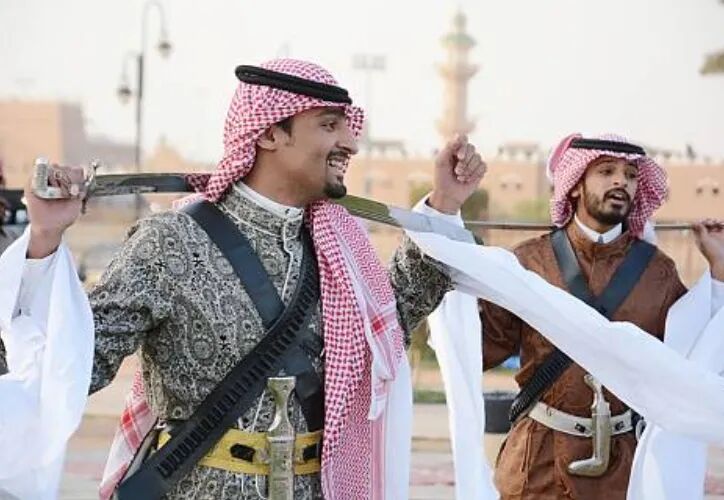
If we were to pick a cultural icon for Saudi Arabia’s intangible heritage, nothing embodies it better than the Al-Ardah dance.
In 2015, Saudi Arabia’s Al-Ardah was officially inscribed on the UNESCO Representative List of the Intangible Cultural Heritage of Humanity, becoming the country’s first cultural item to earn this recognition.
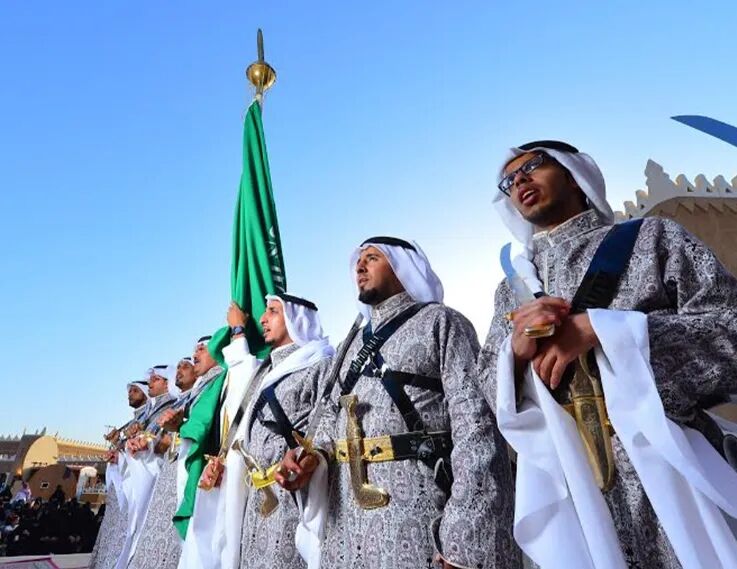
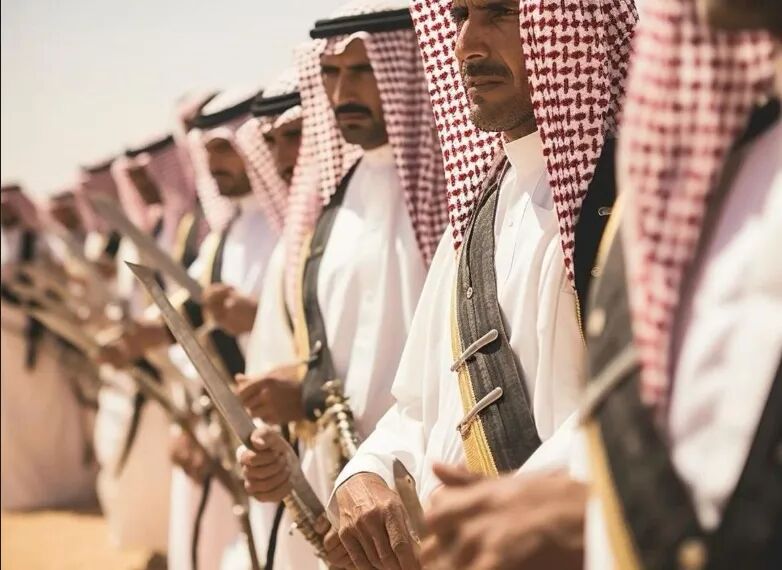
Al-Ardah is a traditional performing art that blends dance, drumbeats, and poetic chanting. Dancers usually line up in two rows facing each other, holding long swords. They move rhythmically back and forth to powerful drumbeats and impassioned verses.
It serves not only as Saudi Arabia’s grand official welcoming ceremony for visiting foreign heads of state at state celebrations, but also as the grand finale at National Day festivities, weddings, and major cultural occasions.
The soul of Al-Ardah lies in its poetry and drum rhythms. The performance opens with the resonant call of Hawalaba. A vocalist with a powerful voice recites two to three lines of verse to align all participants. Poets then chant the main verses, while drummers strike the Tahmiri and Taslis drums in sequence. The tempo gradually builds from slow to a stirring climax.
At the end, performers gather around the national banner, raise their swords high, and chant oaths of loyalty to the nation’s leaders, bringing the entire performance to a magnificent close.
This unique harmony of poetic recitation and warrior dance has been preserved and passed down for hundreds of years.
Perfect Blend of Elegance and Skill: the Al-Mezmar Stick Dance
(Al-Mezmar Stick Dance)
Perfect Blend of Elegance and Skill
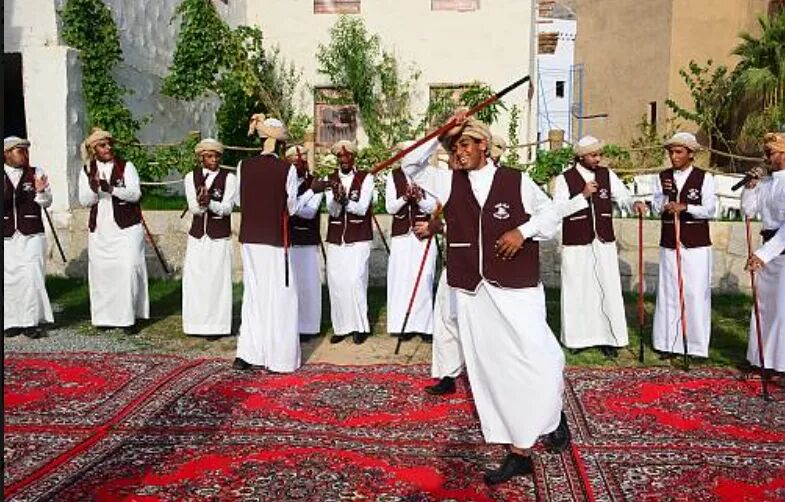
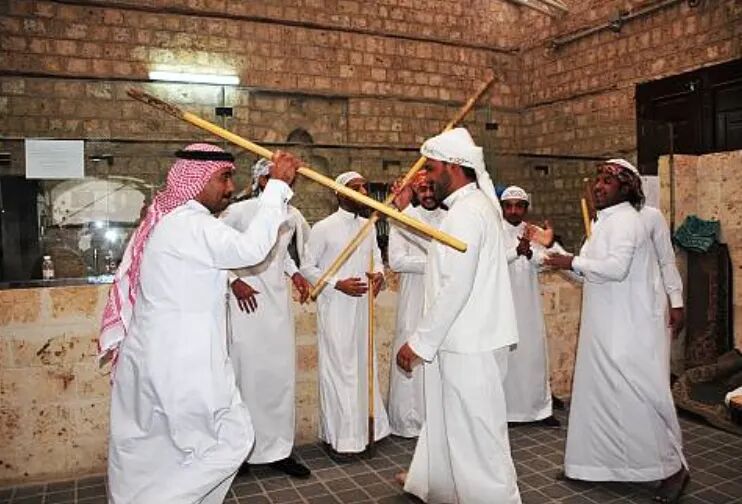
In 2016, Saudi Arabia’s stick dance Al-Mezmar was successfully inscribed on the World Intangible Cultural Heritage List.
It is a traditional group performance popular in the Hejaz region of western Saudi Arabia, often staged at weddings, family celebrations and national festivals.
The most distinctive feature of Al-Mezmar is that performers hold slender wooden sticks and line up in two rows. Accompanied by drumbeats and clapping, the lead dancers from both lines twirl their sticks rapidly and gracefully with coordinated body movements. The dance is brisk in rhythm and full of vitality, combining the solemnity of military drills with the fervor of festive celebration.
It is hard to imagine that the stick-and-sword drills passed down over centuries have now evolved into a visual feast showcasing strength and exquisite ritual charm.
The Artistic Code of Desert Daughters: Qatt Murals of Asir
(Al-Qatt Al-Asiri)
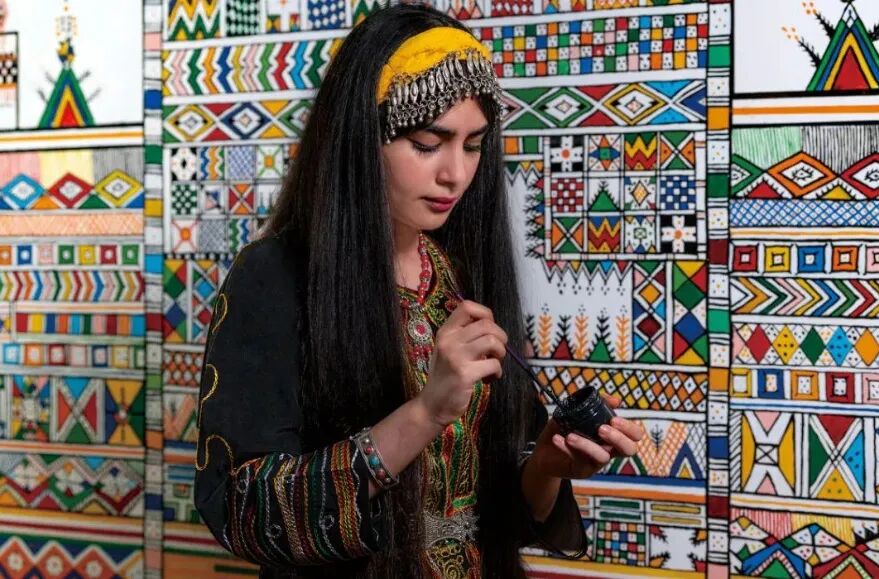
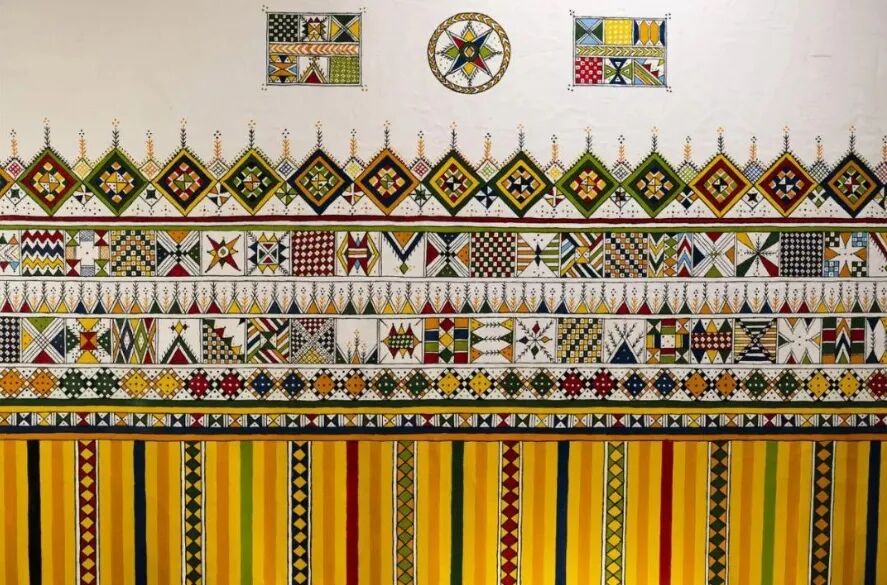
If dance represents male-dominated rituals and glory, the Asir Qatt murals of the southwestern Asir region serve as a secret language of freedom exclusive to local women.This unique wall-decorating art was officially inscribed as intangible cultural heritage in 2017.
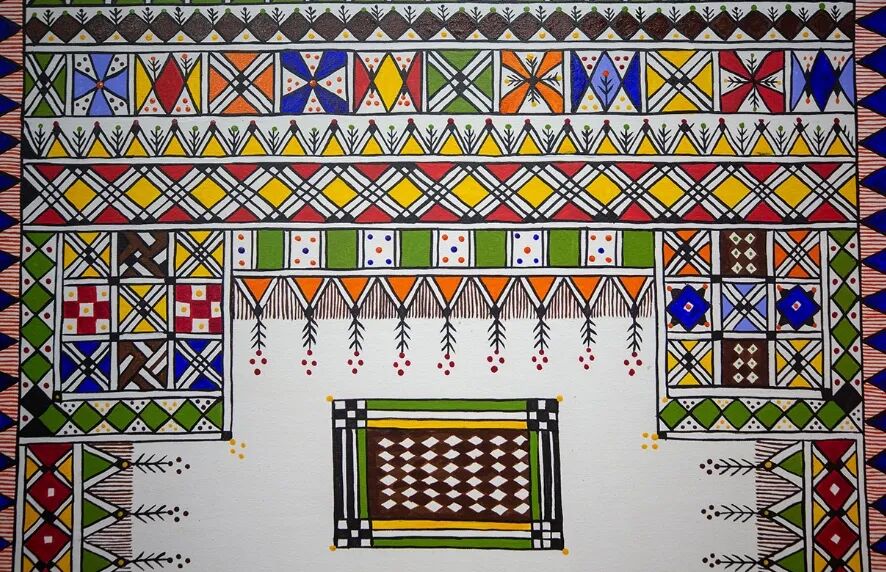
The Asir region is rich in brightly hued natural mineral pigments. Under the traditional local family division of labor—where men work outside the home and women manage household affairs—men build sturdy house frameworks with rocks to withstand hailstorms and heavy rains. Meanwhile, the interior embellishments on walls, ceilings, doors and windows, decorated with geometric patterns in red, yellow, green and other hues, are created collectively by the matriarch of each family together with female relatives and friends.
From design to coloring, the murals require local women to research pigment proportions and create impromptu compositions entirely by themselves. It often takes days or even months to finish painting an entire wall. Ancestral patterns and inherited craftsmanship of each family are passed down from generation to generation amid laughter and conversation, silently becoming a unique cultural bridge for local women to elevate their social and family status.
Its motifs mainly consist of geometric shapes — simple horizontal and vertical lines — and realistic floral patterns. Beneath their plain appearance lies an exquisite philosophy of aesthetics.
Nomadic Memories Woven on the Loom: Sadu Weaving
(Al-Sadu)
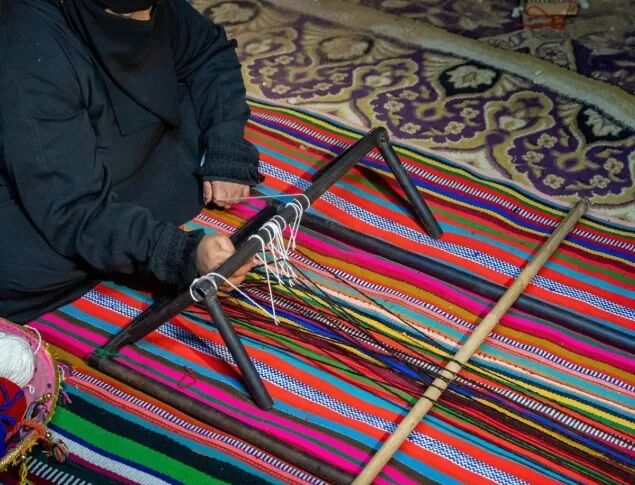
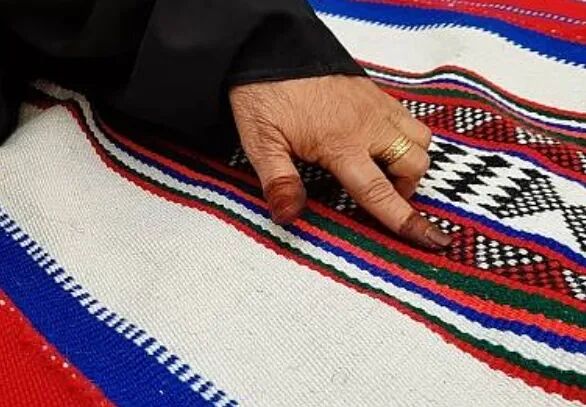
In 2020, the traditional craft of Sadu weaving, jointly nominated by Saudi Arabia and Kuwait, was inscribed on the UNESCO Intangible Cultural Heritage List.
Derived from Arabic, Sadu means “horizontal weaving”. It specifically refers to a warp-faced plain weave technique practiced by Bedouin women on ground looms. Using sheep’s wool, camel wool or goat wool as raw materials, they weave durable tents, carpets and bags.
Sadu textiles are renowned for repetitive geometric patterns in vivid, striking colours with flowing, powerful lines, vividly evoking the undulating sand dunes and sun-scorched textures of desert life.
The emblem of the 2020 Riyadh G20 Summit was designed as an abstract visual symbol inspired by colourful Sadu fabrics, symbolising Saudi Arabia’s respect for and confidence in inheriting its indigenous culture and art.
Today, many young Saudi designers have begun to reinterpret traditional Sadu patterns and integrate them into modern fashion, seamlessly connecting age-old craftsmanship with contemporary aesthetic trends.
A Generous Symbol of Community Bonding: Majlis and Saudi Coffee
(Al-Ardah Al-Najdiyah)
A Generous Symbol of Community Bonding
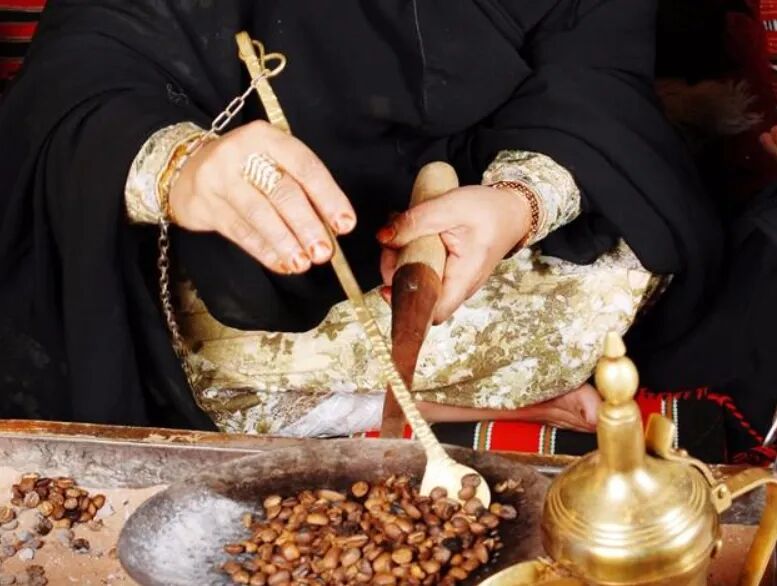

In Saudi Arabia, almost every home features a spacious Majlis—literally meaning “a place of sitting”—carpeted throughout and furnished with scattered floor cushions. It serves as an important venue for family gatherings, neighborhood conversations, and even tribal negotiations to reach mutual agreement.
When receiving guests, the host roasts and grinds coffee beans, then brews them with a touch of cardamom in the traditional coffee pot Dallah. This produces a distinctive golden, richly aromatic coffee, which is poured into handleless small cups called Finjan and offered to every visitor. Guests are expected to drink it in one sip; shaking the empty cup signals that no refill is needed.
In 2015, Saudi Arabia, the United Arab Emirates, Qatar and Oman jointly nominated Majlis and Arabic Coffee, and both were inscribed on the Intangible Cultural Heritage List.
In 2022, the Saudi Ministry of Culture officially renamed Arabic Coffee to Saudi Coffee. This move consolidates Saudi Arabia’s pivotal place in the origin of coffee culture and sends a strong cultural message to the world of traditional generosity, hospitality and universal brotherhood.
Intangible Heritage on the Tongue: Hawlani Coffee Beans and Date Palm Cultivation
(Hawlani Coffee Beans and Date Palm Cultivation)
Intangible Heritage on the Tongue
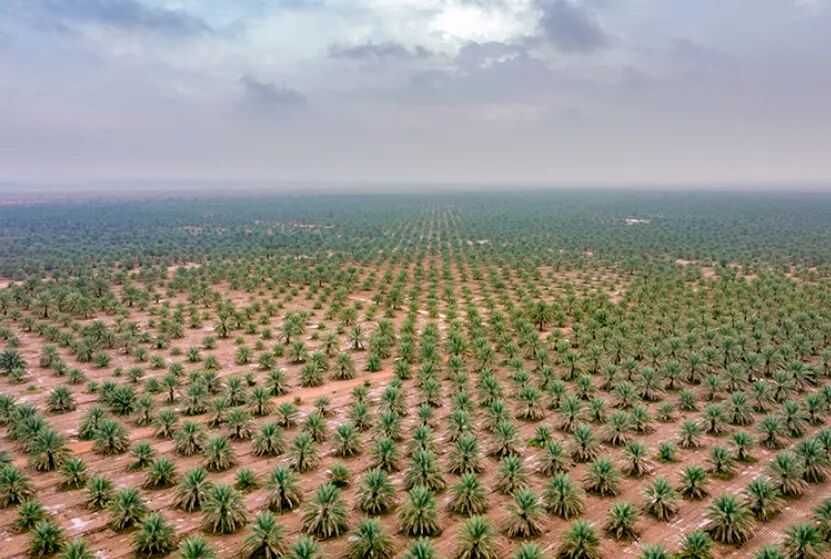
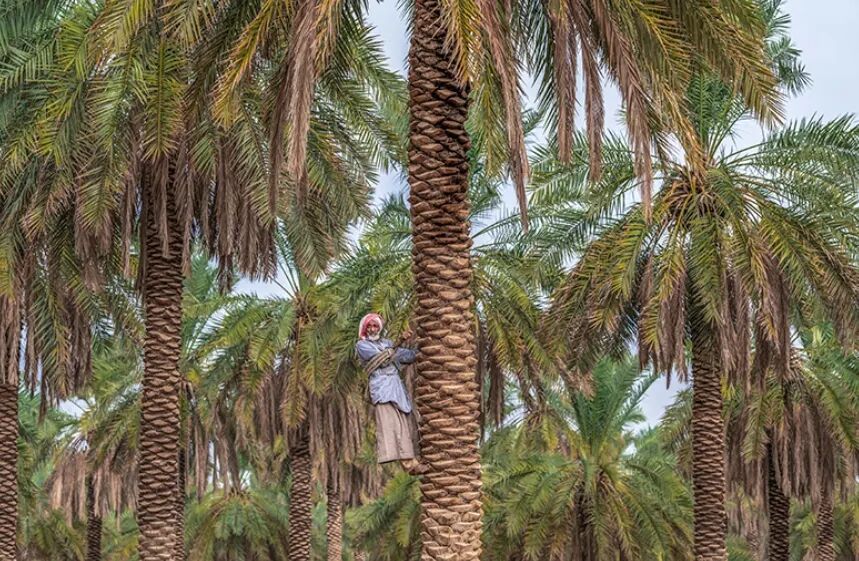
In 2022, UNESCO officially inscribed Knowledge and Techniques of Cultivating Hawlani Coffee Beans onto the Representative List of the Intangible Cultural Heritage of Humanity.
For centuries, the Hawlani tribe dwelling in the mountain terraces of Saudi Arabia’s Jizan Region has been skilled in cultivating this variety of coffee bean. It features a rich fruity fragrance and a faint olive-green luster. Exceptionally aromatic and rare, it is known as “green gold”.
To this day, in remote ancient villages across southern Saudi Arabia, local hosts still entertain distinguished guests from afar with Hawlani coffee beans grown on their own farms, as a gesture of sincere respect.
In 2019, Saudi Arabia, along with 13 other Arab countries, secured collective UNESCO intangible heritage recognition for Indigenous Knowledge, Production Techniques and Associated Traditions Related to the Date Palm.
In Saudi Arabia, the date palm is far more than a time-honored livelihood crop. It embodies desert-bound survival wisdom and local festive customs. Its leaf fibers can be crafted into palm woven products, while its fruits are an essential gift for receiving guests and for pilgrims on their journey, weaving into every facet of daily social life.
Voice of the Desert: Al-Heda‘a and the Oral Traditions of Pastoral Lands
(Al-Heda‘a)
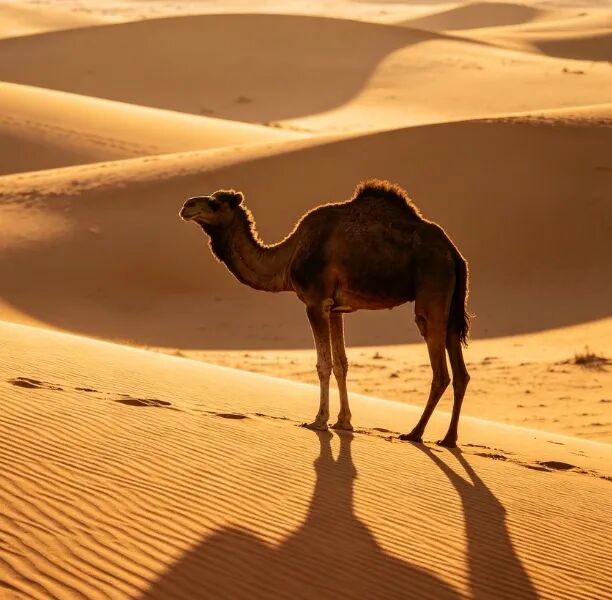
In 2022, Saudi Arabia, Oman and the United Arab Emirates jointly inscribed Al-Heda’a — a unique oral tradition practiced by Bedouin camel herders to rouse and guide camel herds.
Passed down from the ancestors of ancient Arab tribes, herders inherit a repertoire of vocal verses structured around fixed musical scales akin to ancient chants. Their distinctive lingering chants resonate with the vast, stark desert landscape, and these intricate calls align perfectly with the movements of the camel caravans.
This freely improvised oral tradition runs through the entire pastoral cycle: grazing, breeding, milking and migration alike.
From the perspective of modern ecology, history and humanism, it not only preserves the wonderful harmony between humans and animals, but also embodies the echo of wisdom inherent to the authentic nomadic civilization of the Arabian Peninsula.
Calligraphy and Metal Engraving: The Aesthetic Soul of the Arab Nation
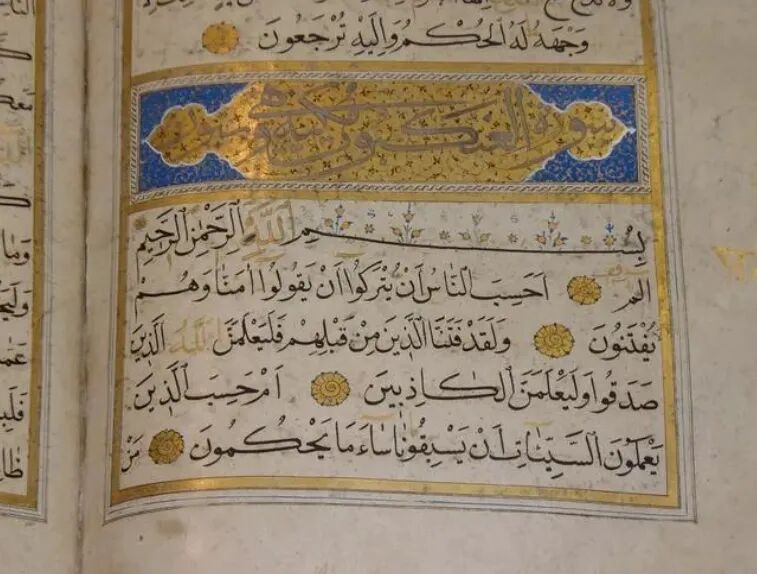
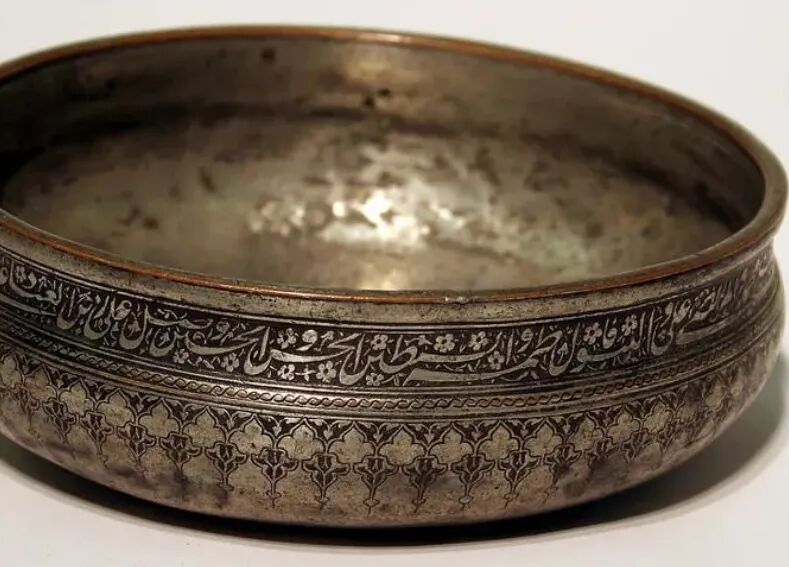
In 2021, Arabic Calligraphy, jointly nominated by Saudi Arabia and 15 other countries, was officially inscribed on the UNESCO Intangible Cultural Heritage List.
From sacred inscriptions on mosque walls to flowing curves adorning everyday metalwork and household pottery, Arabic Calligraphy captivates art lovers worldwide with its rhythmic balance of freedom and discipline, delicate brushwork, and the duality of artistic form and religious philosophy.
In 2023, Saudi Arabia, together with nine other nations, had the arts, skills and practices associated with metal engraving in gold, silver and copper added to the heritage list.
Artisans preserve age-old techniques handed down over centuries, including hand forging, hammering and inlaying. They carve intricate geometric patterns and Quranic verses onto sword scabbards, jewelry boxes, coffee pots and interior ornaments.
A small traditional Dallah coffee pot often requires more than ten days of manual hammering and elaborate engraving, embodying the patience and craftsmanship passed down through generations of Arab artisans.
Melody of the Red Sea Coast: the Semsemiah
(Semsemiah)
Melody of the Red Sea Coast
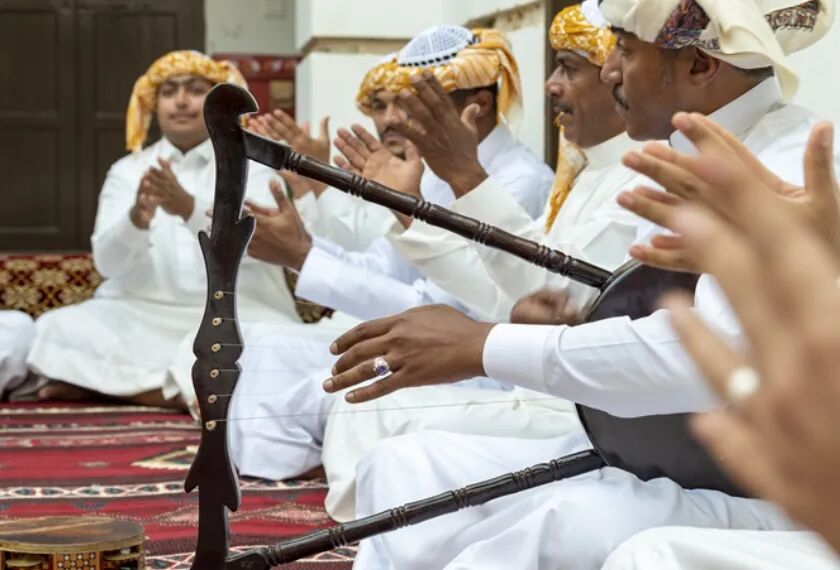
In December 2024, The Craftsmanship and Performance of the Simsimiyya Instrument, jointly submitted by Saudi Arabia and Egypt, was officially inscribed on the UNESCO List of Intangible Cultural Heritage of Humanity.
The Simsimiyya is an ancient stringed instrument shaped like a lyre, typically fitted with 5 to 12 strings. Its resonator is made of wood panels and covered with camel hide. Musicians play the instrument on their thighs or against their hips, producing a melodious, resonant and profound tone.
In port cities along the Red Sea coast such as Jeddah and Yanbu, sailors and fishermen often play the Simsimiyya on sailing ships during long voyages. They sing of drifting across the sea and longing to return home, narrating the magnificent stories of trade and life at this maritime crossroads dating back centuries.
As the craftsmanship of making the instrument and the art of playing it are passed down from generation to generation mainly through verbal instruction and personal demonstration, children usually start learning at around the age of eight. Under the guidance of elder family members, they get to know and inherit this musical gateway that keeps alive the memories of ancient maritime navigation.
Folk Aesthetics of Life: Henna Painting
(Al-Henna)
Folk Aesthetics of Life
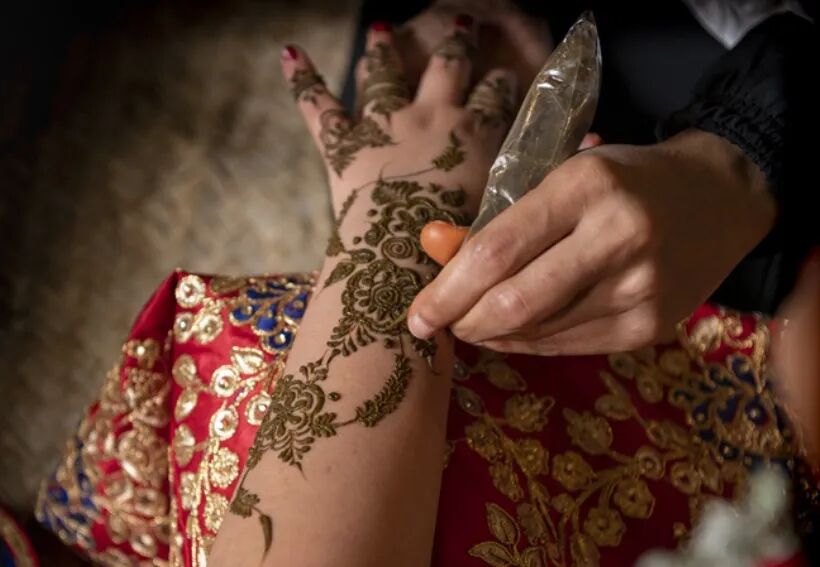
In 2024, Saudi Arabia collaborated with 15 other countries to have henna designs, rituals and social customs collectively inscribed on the UNESCO Intangible Cultural Heritage List.
Far more than simple plant hair dye or body painting, henna plays a vital role on occasions such as engagement ceremonies, the traditional Henna Night before weddings, and festive celebrations including Eid. Women grind henna leaves into a smooth paste and paint intricate lace-like patterns delicately onto their palms, ankles and arms. The artwork expresses women’s hopes, heartfelt blessings and subtle inner sentiments beyond words.
From ancient blessings dating back thousands of years to personalized patterns favored by modern young trendsetters, henna weaves together countless moments of joy and cultural identity across the Middle East and Gulf regions.

Looking back on Saudi Arabia — from the tribal war dances of the vast medieval deserts, to the lingering string melodies of the Red Sea along the ancient Maritime Silk Road, and further to the grand vision of Vision 2030, which strives to drive innovation through heritage preservation and project intangible cultural heritage as national soft power onto the global stage — every cultural practice inscribed on the UNESCO Representative List of the Intangible Cultural Heritage of Humanity stands as a living oral memory cherished and passed down by people over millennia, and a living cultural code woven with perseverance in every stitch and craft.
Perhaps next time you wander through Saudi Arabia’s bustling souks, you will feel an indescribable resonance with the hanging Sadu woven tapestries, handcrafted engraved copper coffee pots, or the fragrant fruity acidity wafting from a brew of antique-hued Hawlani coffee.
There, history has never faded away.
(Images sourced from the internet; removed on request)